
You Can't Give 100% When You're Worried About Safety
Wesley Gundler on why fearlessness starts with the car and the crew around him
Ask a racing driver what lets them push a car to its limit, and you might expect an answer about bravery, or reflexes, or a willingness to live on the edge. Wesley Gundler gives a different one.
For the ENVE Motorsports driver of the No. 46 USF2000 car, going flat out isn't about ignoring the risk. It's about not having to think about it at all. As he puts it, a driver simply can't give everything if part of their mind is occupied with what might go wrong. The freedom to commit fully. To go, in his words, "full boore,” comes from trust. Trust in the car, and trust in the people who show up the instant something happens.
Watch Wesley tell it in his own words:
That trust is the quiet foundation everything else in this program is built on. And it's worth understanding exactly where it comes from, because it's a lot more deliberate than most people watching a race weekend ever realize.
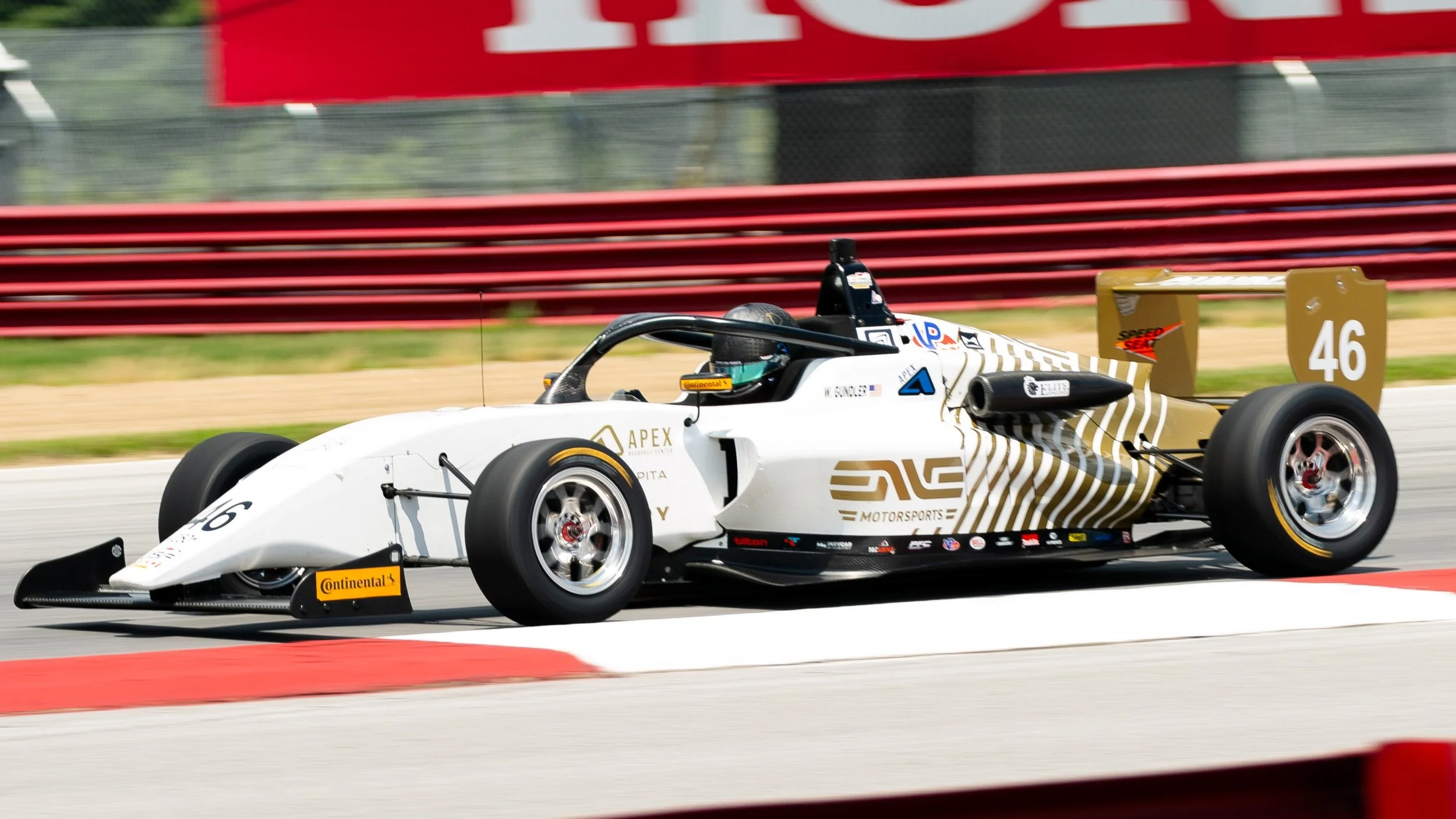
Image courtesy of D Baker Visuals
The car is engineered to protect first
As series spokesperson Rob Howden lays it out, every car on the USF Pro Championships ladder is built around the same principle - absorb the impact, protect the driver. The Tatuus chassis these drivers race is a carbon-composite and aluminum-honeycomb monocoque built to FIA safety standards — a structure designed to soak up a severe hit and keep the survival cell intact.
Wrapped around that core is a full package of protective systems:
The Halo — the cockpit device that deflects large debris away from the driver's head
Side impact panels and front and rear crash structures engineered to crumple and dissipate energy
Front and rear wheel tethers that keep wheels attached to the car during heavy contact or an airborne incident
HANS-compliant INDYCAR head restraints that limit dangerous neck movement in a crash
For the US ladder specifically, the cars carry extra reinforcement. Howden points to the double bulkhead in the front of the monocoque and the added side-intrusion protection — upgrades built for the unique punishment of American oval tracks like the Milwaukee Mile. These aren't off-the-shelf cars. They're purpose-hardened for exactly the racing these young drivers do.
the Halo changed everything
There's a moment Howden keeps coming back to. In 2022, Dan Andersen — owner and CEO of Andersen Promotions, the company behind the entire USF Pro Championships ladder — insisted the program bring the Halo into these junior cars. For the man whose mission is moving young drivers safely up the ladder toward the NTT INDYCAR Series, it wasn't optional. And the effect has been impossible to argue with since.
The proof shows up race after race, incident after incident. Tire marks on the Halo. Scuffs and scars in places that, without that titanium hoop, would tell a very different story. Every one of those marks is a picture of debris or another car meeting the Halo instead of a driver's helmet. As Howden describes it, that single addition took the program's safety to another level entirely.
It's a good reminder that safety in motorsport isn't static. It's a series of decisions, some of them uncomfortable or unpopular in the moment, that compound over years into something that genuinely saves lives.
The same safety crew as the big leagues
Here's the part that surprises people, USF drivers on this ladder get the exact same trackside protection as the drivers at the top of the sport.
The AMR Safety Team, the professional crew that responds to incidents at NTT INDYCAR Series events, is on site across the USF ladder too, because nearly every one of these races runs in support of an IndyCar weekend. That means full INDYCAR-level infrastructure: rapid-response crews, paramedics ready to make an on-track assessment, motorsports-trained medical staff, and post-incident safety checks after any contact
Gundler is blunt about what that means to him as a driver: the response is fast, the equipment is sturdy, and so the thought of getting hurt simply isn't in his head when the visor comes down. That's not recklessness. That's a professional environment doing its job so the driver can do theirs.
And it matters beyond the cockpit. For families watching from the stands — many of whom didn't grow up around racing — seeing a professional safety crew bring a driver in and run the checks after an incident is what turns nervous spectating into genuine confidence. It's what lets them enjoy the sport instead of holding their breath.
Safety is where that seriousness is easiest to see. The engineering, the Halo, the AMR crew, the oval-spec reinforcement — these are the details that separate a real professional development ladder from a dream on a spreadsheet. When a business partner joins the Grid, or a racing family commits to the climb, they're investing in a program where the driver at the center of it is genuinely protected, and free to give everything they've got.
Because Gundler is right. You can't give 100% when you're worried about your safety. And the whole point of what we're building is to make sure these drivers never have to.
