
The Rise of IndyCar: Why 2026 Is Changing the Conversation
Something is shifting in American motorsport, and the numbers are no longer just suggesting it; they are confirming it. The 2026 NTT INDYCAR SERIES season has delivered a milestone not seen in nearly two decades: the first three races of the year have each been watched by more than one million television viewers. As reported by IndyStar, that hasn't happened since 2008, the year American open-wheel racing reunified into a single series.
The inaugural Java House Grand Prix of Arlington drew 1,336,000 viewers on March 15. That’s a 142% increase over the comparable race from the 2025 season, and a 54% jump over last year's FOX Sunday average (excluding the Indianapolis 500). The season's average across its opening three rounds now stands at over 1.3 million viewers per race, up 48% year over year.
For the first time since 2008, IndyCar has averaged more than 1 million viewers across its first three races of the season. The momentum is real, the audience is growing, and the entry point for brands has never been more compelling.
The broadcast numbers tell only part of the story. Every IndyCar race on FOX is simultaneously available to stream through major platforms — Fubo, YouTube TV, Hulu + Live TV, and DirecTV Stream — meaning the audience extends well beyond traditional television households. Internationally, IndyCar LIVE now delivers coverage across more than 200 countries and territories. In 2025, FOX reported that IndyCar had the fastest viewership growth curve of any major sport.
For brands evaluating where to invest their marketing dollars and build meaningful connections with audiences, this moment matters. The question is not whether open-wheel racing is growing. It is whether your brand will be part of that growth story.
Understanding the IndyCar Ecosystem
One of the most misunderstood aspects of IndyCar — and one of the most compelling from a brand perspective — is that it is not a single series. It is a complete ecosystem of racing at multiple levels, from entry-level open-wheel cars driven by teenagers to the fastest road course machines in North America. Together, these series form the Road to IndyCar, a structured development ladder that produces the next generation of racing talent.
Each level feeds into the next. Champions at every rung earn scholarship funding to move up. Drivers who begin at the base of the ladder in regional karting competitions can, with talent and the right support, find themselves competing at Indianapolis within just a few seasons. That journey and the ecosystem around it represent a unique and layered opportunity for brand partners.
The Road to IndyCar Development Pathway
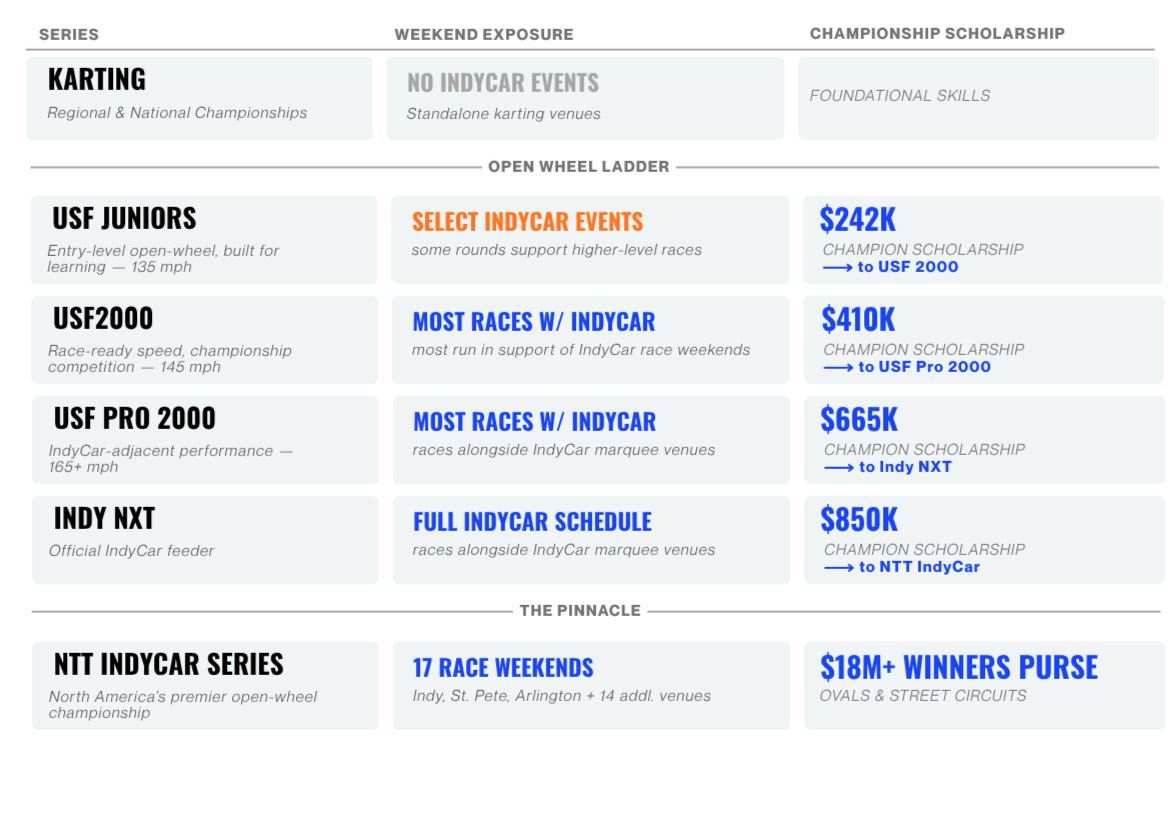
What makes this ladder genuinely remarkable is that it is a single, continuous pathway. A driver who starts in karting can reach IndyCar with the right combination of talent, development, experienced guidance, and partnership support—and the ability to make the right decisions at the right time—on a defined timeline, with formal scholarship recognition at every step along the way.
Race Weekends: Where the Entire Ecosystem Comes Alive
One of the defining characteristics of the IndyCar model is that race weekends are not just IndyCar weekends. At most events on the calendar, support series races are part of the program. That means a single race weekend can bring together drivers competing across USF2000, USF Pro2000, Indy NXT, and the main NTT INDYCAR SERIES, all in front of the same crowd.
For fans, this is an extraordinary value proposition. Over the course of a weekend, you can watch teenagers taking their first proper steps in single-seater racing in the morning, follow an Indy NXT battle between tomorrow's IndyCar stars in the afternoon, and then see the full NTT INDYCAR SERIES field go racing for the main event. No other motorsport platform in North America offers this depth of content across a single ticketed experience.
For brand partners, the implications are equally compelling. A presence at an IndyCar race weekend is not a presence in one race. It is a presence across an entire day — often an entire weekend — of racing content, consumed by a live audience and a television and streaming audience that continues to grow. Brand visibility is layered, repeated, and contextually rich in a way that few sporting properties can match.
A race weekend is a multi-act event. From the first lap of the support series to the final turn of the IndyCar race, brands are present across hours of live action and a fanbase that spans every level of engagement with the sport.
Beyond the broadcast and live audiences, IndyCar race weekends offer something most sports simply cannot: genuine access. Paddock passes, pit lane walks, driver appearances, and hospitality experiences bring brand partners and their guests into direct, close contact with the racing environment. For a prospective client or senior stakeholder, spending a race morning in the paddock — watching cars being prepared, meeting drivers, and seeing the sport's operation up close — creates an impression that no marketing deck can replicate. That access, and the conversations it generates, is one of motorsport's most undervalued assets.
Where Apex Sits in This Moment
Everything described here — from the surge in viewership to the structure of the development ladder and the immersive nature of race weekends — underscores a simple reality: IndyCar is entering a new phase of growth.
At the center of that growth are the drivers moving through the system today and organizations like Apex Resource Center that support and develop the next generation of IndyCar talent.
For brands, partners, and stakeholders, the opportunity isn’t just to observe that growth, but to align with it while it is still gaining momentum.
FREQUENTLY ASKED QUESTIONS
-
The IndyCar development ladder, also called the Road to IndyCar or USF Pro Championships, is a structured series of open-wheel racing championships that feed into the NTT INDYCAR SERIES. From entry level to pinnacle: USF Juniors, USF2000, USF Pro 2000, Indy NXT, and the NTT INDYCAR SERIES. Champions at each level earn scholarship funding to advance. Most rounds run in direct support of IndyCar events, meaning development series drivers race in front of the same live crowds and television audiences.
-
Brands can partner with IndyCar development drivers at the USF2000, USF Pro 2000, or Indy NXT levels through direct sponsorship arrangements with teams and driver management organizations, such as Apex Resource Center. Entry points are significantly more accessible at the development level than at the IndyCar level, while still offering live event presence, streaming impressions, social and digital content, and paddock hospitality access for clients and stakeholders.
-
IndyCar race weekend sponsorships typically include branding opportunities, paddock and pit lane access, driver appearances and hospitality opportunities, social media content, and visibility across broadcast and streaming platforms. Because support series such as USF2000 and Indy NXT run alongside the main IndyCar event, brand presence extends across multiple races and sessions over a single weekend, creating far more touchpoints than most conventional sports sponsorships deliver.
-
IndyCar viewership is growing faster than any other major sport in America, according to FOX Sports. The 2026 season has already delivered three consecutive races above 1 million viewers — the first time since 2008. As the series gains broader mainstream attention, sponsorship costs at the IndyCar Series level will naturally rise. Brands that establish a presence now at the development ladder level can build equity and an authentic driver association before that window narrows.
-
Yes. Motorsport is one of the few sports that offers direct, close-contact access to athletes and teams as a standard part of sponsorship. Paddock passes, pit lane walks, and driver hospitality are routine elements of race weekend packages. For brand partners, this creates a client entertainment and stakeholder engagement platform that most other sports cannot match.
-
Apex Resource Center is a driver development and brand partnership organization operating across the IndyCar development ladder. Apex connects brands with their drivers and creates programs that align with their audience, values, and long-term objectives — at the level of the ladder that fits their goals and budget. The focus is on authentic, meaningful partnerships grounded in the genuine growth story of American open-wheel racing. Contact us at trish.johnson@apexresourcecenter.com to start the conversation.
